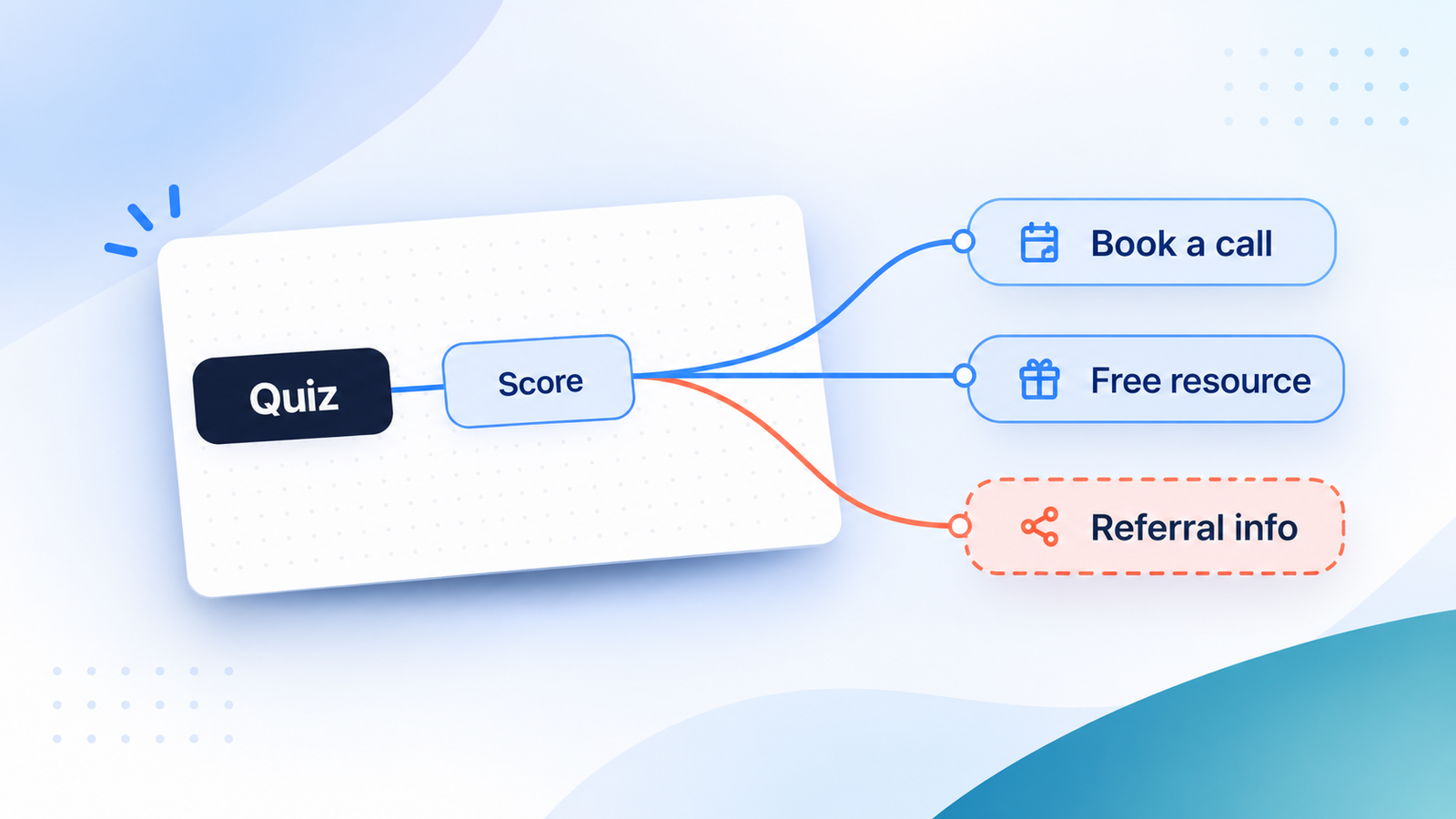

A quiz funnel for therapists is a short, scored questionnaire that people complete before they book a discovery call. It replaces the blank contact form with a few questions, gives each person a result that is useful on its own, and tells you who is a good fit before you spend 20 minutes on the phone. It does not diagnose anyone, and it should never try to.
Quiz funnel or intake form: what changes
An intake form collects information so you can start working with someone who has already decided to work with you. A quiz funnel sits earlier. It helps a person who is still deciding understand where they are, and it helps you understand who they are.
- A contact form asks the visitor to give first: name, email, message. Nothing comes back until you reply.
- A quiz funnel gives first: a result and a next step arrive the moment they finish. The email address is the price of the result, not a gate in front of a blank page.
For the psychology behind this, read Quiz Funnel Conversion in Mental Health: The Psychology.
The five steps of a therapist quiz funnel
- Entry. A page or post that promises one clear thing, such as “Find out which kind of support fits you right now.”
- The quiz. Five to ten questions, one per screen, written in plain language.
- The email step. Ask for a first name and email before showing the full result. Say what you will send and how often.
- The result page. A short, specific description of what the answers suggest, with one next step that matches the result.
- Follow-up. A short email sequence that matches the result, not one generic welcome email.
Writing the questions
Good questions are about the situation, not the diagnosis. Compare “Do you have generalised anxiety disorder?” with “In the last month, how often has worry kept you awake or made you cancel plans?” The second one describes a life, and the person can answer it honestly without a clinical label.
Keep three rules in mind:
- One idea per question. If you wrote “and” in the question, split it.
- Offer answer choices that cover the range, including a way to say “not really.”
- Ask about readiness as well as need: “How soon would you like to start?” tells you more about fit than any symptom question.
A simple scoring example
This is an illustration, not a clinical tool. Imagine a six-question quiz for a private practice that sees adults for work-related stress. Each answer adds points on two axes: how much the stress is affecting daily life, and how ready the person is to start.
- High impact, ready to start: the result invites them to book a discovery call and shows your next available times.
- High impact, not ready yet: the result points to a free resource and an email series, with a softer invitation to talk later.
- Lower impact: the result explains what is normal, shares two practical steps and offers a newsletter.
- Outside your scope: answers that suggest a crisis or something you do not treat lead to a page with appropriate emergency and referral information, not a sales message.
The last bucket matters most. Build it first. A quiz that cannot say “this is not for you” will eventually say the wrong thing to the wrong person.
What the result page should do
- Open with what the person told you, in their terms, not a label.
- Say plainly that the result is not a diagnosis and not a substitute for an assessment.
- Offer one next step that matches the result. A single clear button beats three options.
- Show who you are: a real name, a real photo, your licence or registration details where your jurisdiction expects them.
Ethics, scope and privacy
Your professional body’s advertising and confidentiality rules still apply to a quiz. Check them before you publish.
- Do not diagnose. Describe patterns and options. Leave diagnosis to an assessment.
- Do not promise outcomes. Avoid language that suggests the quiz or your service will cure or guarantee anything.
- Get clear consent. Tell people what you collect, why, and how to ask for it to be deleted.
- Treat answers as sensitive. If you are a covered entity under US health privacy law, ask any tool vendor in writing whether they will sign a business associate agreement, and where the data is stored. Do not assume that a quiz tool is covered because it is popular with practitioners.
- Plan for crisis answers. Decide in advance what the quiz shows if someone answers in a way that suggests they are at risk.
What to measure
Track four steps and look for the biggest drop: people who see the entry page, people who start, people who finish, people who leave an email, and people who book. We are not quoting benchmarks here, because rates vary a lot by audience and traffic source. Your own numbers after 100 or so visitors will tell you more than anyone else’s average.
Common mistakes
- Fifteen questions where six would do.
- Asking for an email before the person has any reason to trust the quiz.
- The same result page for everyone.
- No follow-up email, so the result goes nowhere.
- Clinical wording in the questions that the reader does not use about themselves.
Choosing a tool
Pick a tool that lets you score on more than one dimension, send people to different result pages, and connect to your email service. Our Interact alternatives guide compares plans and prices for several, and the guide to behavioral funnels covers the thinking behind routing people by their answers. FlowlyOS is a node-based builder for practitioners, currently in private beta, with a waitlist at flowlyos.com.
Questions people ask
Is a quiz funnel appropriate for a therapy practice?
It can be, if it stays within your scope, does not diagnose, makes no promises about outcomes and follows your professional body’s rules on advertising and confidentiality. Check those rules for your jurisdiction before publishing.
How many questions should a therapist quiz have?
Five to ten is a sensible range. Start with the fewest questions that let you tell a good fit from a poor one, and add more only if you can name what each extra question changes.
Should the quiz ask for an email address?
Usually yes, after the last question and before the full result, with a plain explanation of what you will send. Let the person see enough of the result first to know it is worth the exchange.
Can a quiz replace a discovery call?
No. It decides who gets a call and what the call can focus on. The call is still where fit is confirmed.
Last updated 2 November 2026. This article is general information, not legal, clinical or compliance advice.